
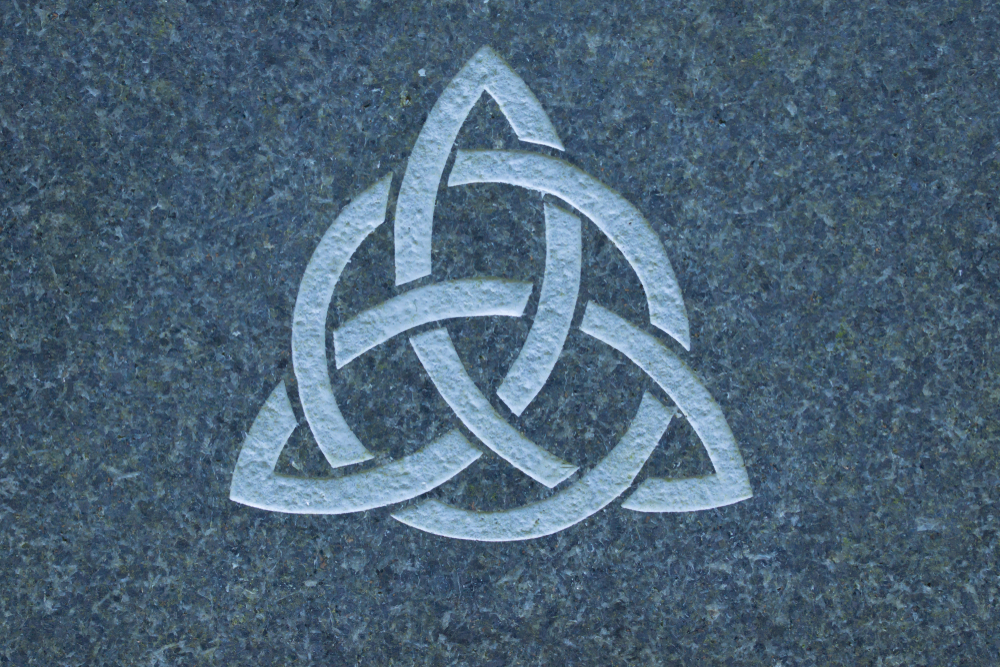
Is the Hindu Trimurti the Same as the Christian Concept of a Triune God?
The Hindu Trimurti (also called the Hindu Triad) is comprised of three individual deities at the top of the Hindu pantheon: Brahma (the creator-god), Vishnu (the preserver-god), and Shiva (the destroyer-god). Sometimes, those who subscribe to Hinduism or New Age Spirituality claim this mirrors the concept of the triune nature of the God as presented in the Bible (the Father, the Son, and the Holy Spirit). However, the differences are radical, not marginal: the concept of a Triune God (often referred to by Christians as the Trinity) upholds ONE indivisible Godhead, while the Trimurti emphasizes functional diversity among distinct individual gods.
Let’s begin by examining on a very basic level some mythical stories featuring these three prominent Hindu deities.
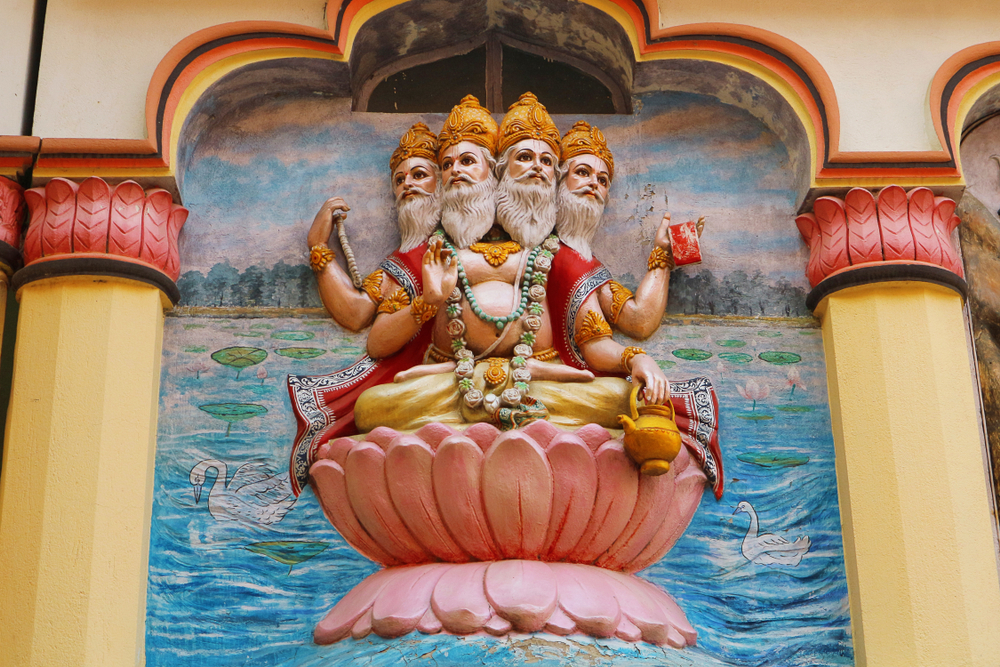
Brahma—The creator-god, Brahma, is depicted as a five-headed deity and there is a fabled twist about how that happened. Supposedly, after creating the universe, Brahma created a beautiful woman named Satarupa (or Saraswati)—the first woman married to the first man, Swayambhuva Manu. Then Brahma became overly enamored with her (though in a sense, she was his own daughter). Satarupa felt embarrassed and tried to evade his gaze. Every time Brahma looked in a new direction to keep her in his sight, a new head sprouted, resulting in his five-headed form (four facing outward in four opposite directions and one facing upward). As punishment for his lustfulness and arrogance, Shiva—the destroyer god—cut off Brahma’s fifth head (depicted as a manifestation of his ego). Mythologically, therefore, Brahma is portrayed in a very non-divine way: incestuous, lecherous, and vulnerable.
There is another legend offered in explaining this head-loss. In it, Brahma is characterized as egotistical, prideful, and dishonest. Brahma and Vishnu were debating over who was superior. To assert his dominance, Shiva manifested as a massive, endless pillar of fiery light (called the Jotirlinga). Shiva challenged both Brahma and Vishnu to find the end of the pillar (Brahma, looking for the top, and Vishnu, looking for the bottom).
In the form of a boar, Vishnu searched downwards, finally honestly admitting he was a failure and acknowledging Shiva as the supreme deity. In the form of a swan, Brahma flew upwards but was unable to find the top. However, He deceitfully claimed to succeed, and used a Ketaki flower as his false witness. Enraged by this blatant lie, Shiva emerged from the pillar and punished Brahma by cutting off one of his heads. He also pronounced a curse over him, declaring that Brahma would not be worshiped in a predominant way (though supposedly, he was later restored after a pilgrimage and penance). So, this supposed ‘creator-god’ is also portrayed as a liar. Also, two completing contradictory stories are offered concerning the dilemma. That’s bothersome, makng any claim to legitimacy unsupportable.
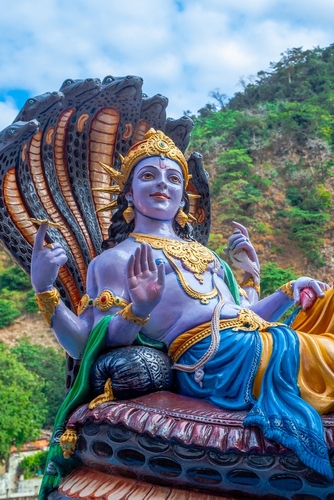
Vishnu, the preserver-god, is known for his ability to manifest as either gender, male or female. He also has human-like attitudes tending toward selfishness and corruption. Supposedly, during the churning of the ocean, both the Devas (gods) and the Asuras (demons) were working together to obtain amrita (the nectar of immortality). When the amrita was produced, Vishnu assumed the form of a beautiful maiden named Mohini to deceive the Asuras. Mohini distributed the nectar only to the Devas, securing immortality for them alone, so they emerged cosmically victorious and superior over the Asuras. This is generally viewed as a selfish, deceitful, and egotistical act on Vishnu’s part.
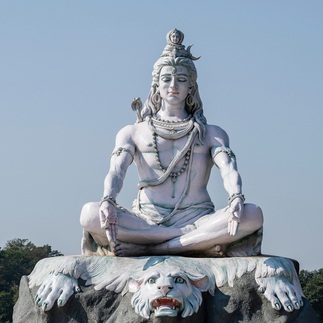
Shiva, the god of destruction, is known to have outbursts of anger. Then, at times, he regrets his actions and feels compelled to repair the mistakes his ignorance or rage cause. For instance, he decapitated Ganesha because he did not know his female consort Parvati had created Ganesha in a fully human form to guard her while she bathed. To repair his error, he had his servants bring the severed head of an elephant from earth and he placed it on Ganesha.
Shiva also went into a fit of anger because the father of his wife, Sati, did not approve of their marriage. As his temper flared, he threw one of his dreadlocks to the ground and it erupted into a violent deity named Virabhadra. This newly created being, propelled by Shiva’s desire for vengeance, charged violently into a banquet feast being conducted by Daksha, Sati’s father, and beheaded him, slaughtering other deity guests as well. Later, Shiva regretted this act and placed the head of a goat on Daksha. So, this deity has an explosive, uncontrolled temper that sometimes results in destructive behavior.
Literal or Allegorical?
Some of those who subscribe to a deeper, more profound, philosophical interpretation of the Vedas (Hindu Scripture), such as Advaita Vedanta Hinduism, would insist that these myths are not to be taken literally, but are symbolic in nature. They are merely allegories that convey deeper, philosophical truths, ethical lessons, and principles of cosmic function. As my dear friend, former yogi, Michael Graham, explains, “They have little regard for these mythical beings, but they do not disdain them.” Considering themselves on a higher, more spiritual level, they would likely offer the explanation that these peculiar stories are helpful teaching tools, revealing important life principles to simpler minds.
The true God—As revealed in the Bible, the true God is triune in nature (Father, Son, and Holy Spirit), yet these three are one—one divine reality in three co-eternal, co-equal, consubstantial (of the same substance) Persons. As I already mentioned, this is often referred to as the “Trinity”, but I prefer to use the word “Triunity”—because they are not three individual gods, but ONE GOD—a mystery that will only be fully comprehended when we reach the eternal state (Matthew 28:19, 1 John 5:7).
This “true God” is omniscient and all-knowing (1 John 5:20). Therefore, He would never make errors in judgment like Shiva, either because of ignorance or misunderstanding. He is perfect love, not subject to fits of unbridled rage He later regrets. The true God, being utterly pure and holy, would never be guilty of incestuous lust like Brahma. The true God is never motivated by selfishness or egotism.
The true God speaks only truth, so He would never be found lying or deceiving. His Spirit is called “the Spirit of truth” (John 14:17). His Word is called “the Word of truth” (Ephesians 1:13). And during the incarnation, the Son of God even declared, “I am the truth” (John 14:6). No wonder the Triune God is called “the God of truth” (Isaiah 65:16).
This everlasting Creator is not subject to character flaws. All the fables about Hindu deities expose negative, human-like frailties and faults. The biblical Godhead (Father, Son, and Holy Spirit) is perfect in all His ways. (See Psalms 18:30.) Because He is the perfection of love, traits like pride, selfishness, lust, and deceit would never be found in Him.
Moreover, the myths of Hinduism often show major conflicts between chief deities as they wrangle for superiority. On the contrary, there is perfect, undisturbed harmony and unity between the Father, the Son (Jesus), and the Holy Spirit. They always work in perfect union, and once again, they are co-equal.

The Son of God, Jesus, is referred to as “the Word” who was in the beginning with God and who was God (John 1:1). That is in no way related to the Hindu belief that the word “OM” was the first word accompanying the manifestation of the universe. It rather means that Jesus was the One the Father spoke through to bring forth creation by the Holy Spirit. As the eternal Word, He declared a series of intelligible statements like “Let there be light,” not a single, guttural, one-syllable sound, to later be droningly and monotonously chanted by human beings, over and over again, in the hope of achieving God-consciousness.
Four final statements:
- No transcendent, impersonal force above the Triune God—In Advaita Vedanta Hinduism (the monistic, Hindu view of God and the universe), Brahman is Ultimate Reality: an impersonal life-force that manifests as 330 million deities (the traditional number). In this pantheon, the three dominant gods manifested out of Brahman are Brahma, Vishnu, and Shiva. However, in Christianity, there is no superior, impersonal, source of power, no underlying “Life-force” that brings forth lesser deities known as the Father, Son and Holy Spirit. The three-in-one God of the Bible is “Ultimate Reality.” There is nothing above or beyond Him. Moreover, this “Ultimate Reality” is personal, not impersonal.
- Altered state of existence—There is an elaborate schedule of cyclical ages in Hinduism, divided into kalpas and years of Brahma. At the end of one hundred years of Brahma (which equals 311,040,000,000,000 years), Brahma, the creator god, enters a state of deep sleep or quiescence (dormancy)—a time of unmanifestation (Pralaya). During that time, the entire manifested universe, including most deities and living beings, withdraws into an unmanifested “seed” state, dormant and unproductive, resting until the dawning of the next day of Brahma. On the contrary, the true God is “from everlasting to everlasting” (Psalm 90:2). He is immutable; He never changes and He never “sleeps” or “slumbers.” Once He brings forth the New Creation, it will be a permanent, eternal transformation (Psalms 121:3-4, See Malachi 3:6, 1 Timothy 6:16, Revelation 21:1-5.)
- No other gods—Possibly, the plainest, most blatant response to these Far Eastern concepts is discovered at Mount Sinai, from which the true God audibly declared His “10 Commandments” and provided Moses and the children of Israel a record of them, written on tablets of stone. The first in the list is “I am the Lord your God [Hebrew Yahweh Elohim] . . . you shall have no other gods beside Me” and the second, “You shall not make any graven image” (Exodus 20:1-6). The beliefs and practices of Hinduism (including the worship of idols representing their deities) are an evident transgression of these two commandments, for as Psalm 96:5 declares, “All the gods of the nations are idols.”
- Final conclusion: my motive—Why have I written this article and why are these issues important? Because when I was a yoga teacher in 1970, I assumed these deities actually existed, but then, once I encountered the true God, I realized they were not real. They are simply the product of human imagination. So worship expressed toward them is futile and unfulfilling—a religious practice that does not meet the deepest need of the human heart. Those who desperately hunger to be completed by a relationship with God need to know the truth, so they can walk the proper path. So my innermost motive in sharing these things is not to be critical or judgmental concerning another person’s cherished belief system, but because I long to help others experience spiritual wholeness.
MY APPEAL TO YOU!
If any person who embraces a non-Christian worldview (Hindu, Sikh, New Age, etc.) reads this article, I urge you to open your heart to the true and living God—the eternal I AM—the holy One who came to this world in the form of a man and presented the way back to oneness with the Everlasting Father. Only Jesus was born of a virgin. Only Jesus lived a sinless life. Only Jesus died on a cross for the sins of humanity. Only Jesus rose again, shaking off the shackles of death.
I urge you to ask Jesus to reveal Himself to you, to come into your heart, to wash away your sins, and to fill you with the Holy Spirit. He promised to grant spiritual rebirth (the wondrous experience of being “born again”–John 1:12; 3:1-7) to those who receive Him as the Lord of their lives. Most importantly, He also promises the gift of eternal life. Pray and ask Him to fulfill these promises for you and in you—because God will responds to those who dare to believe.
If you are interested in understanding this beautiful concept of being “born again” more fully, read the article, “The Wonder of Being Born Again.”
